Example polls
Paste any of these into the message box in Slack.
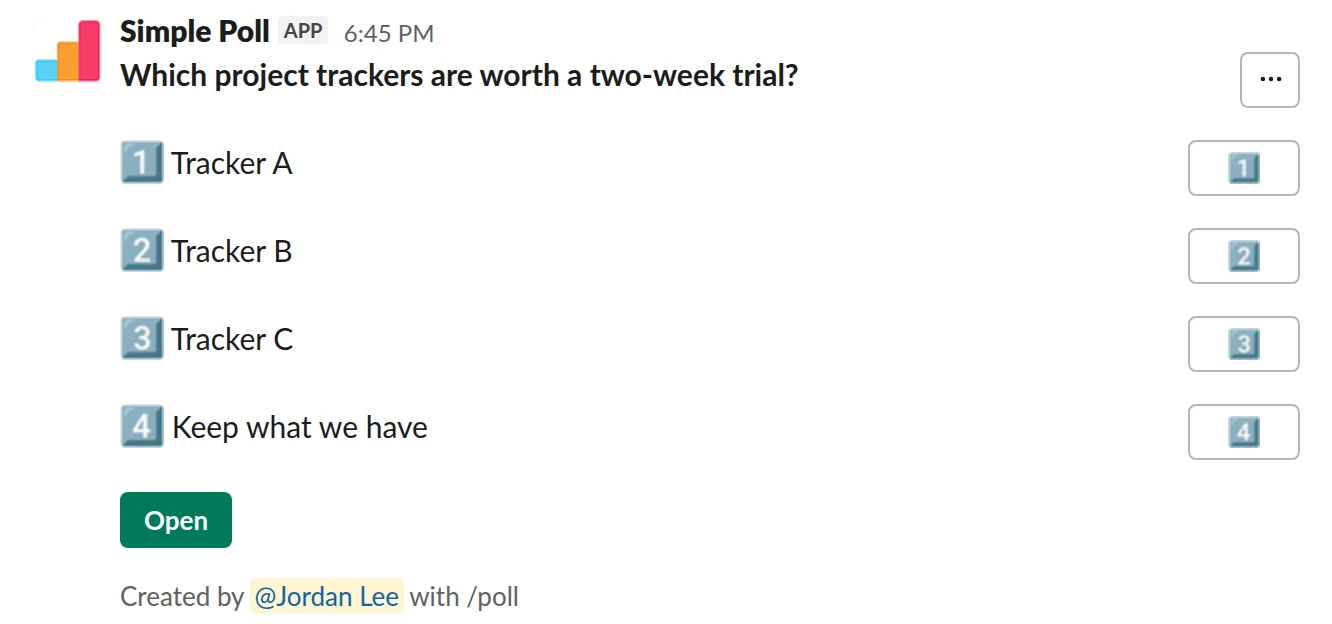
Choice poll. Round one. Multiple picks allowed, so you learn which tools have support at all.
/poll "Which project trackers are worth a two-week trial?" "Tracker A" "Tracker B" "Tracker C" "Keep what we have"
Free
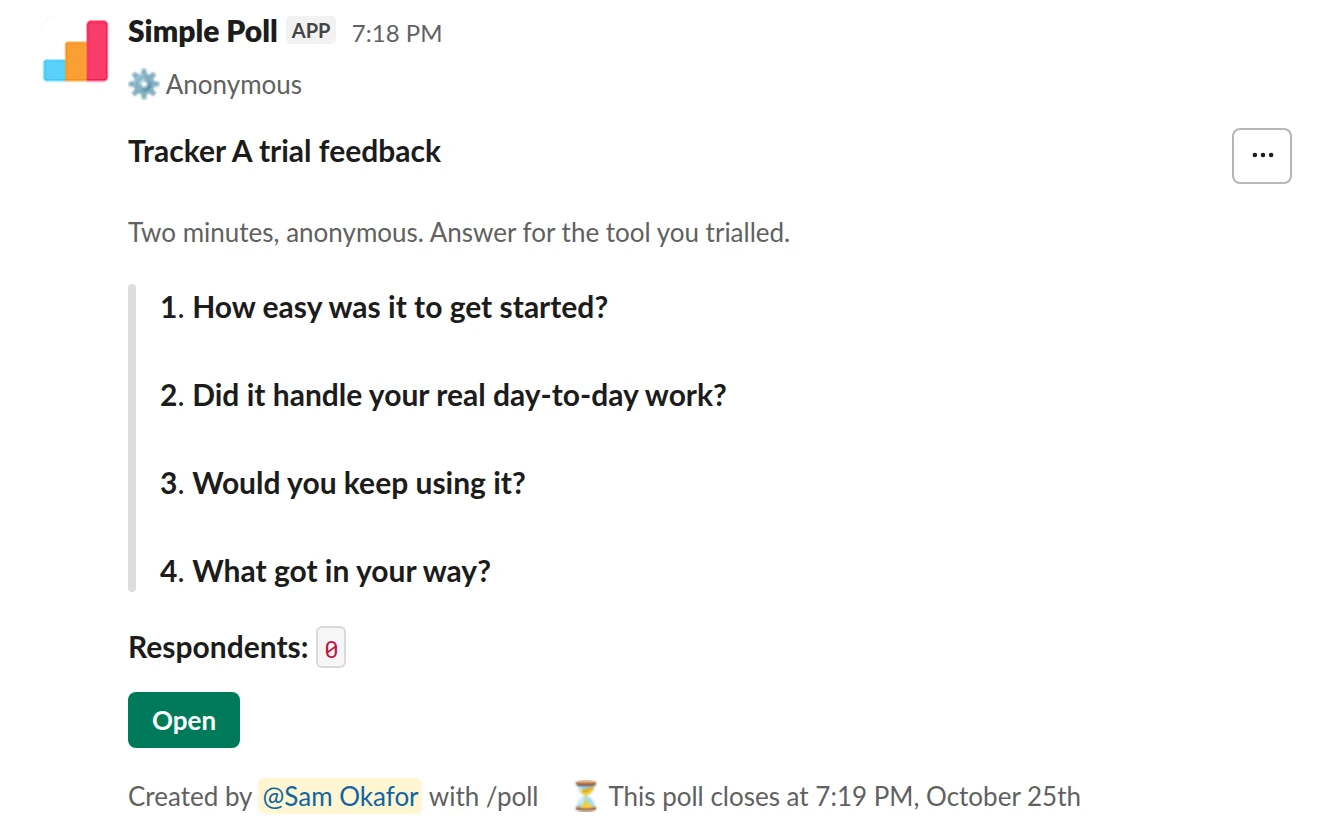
Survey (4 questions). Round two. The post-trial survey, anonymous, closing after three days.
/poll "Tracker A trial feedback" "Two minutes, anonymous. Answer for the tool you trialled." anonymous close after 3 days --- "How easy was it to get started?" "Very hard" "Hard" "OK" "Easy" "Very easy" scale --- "Did it handle your real day-to-day work?" "Yes" "Mostly" "No" limit 1 --- "Would you keep using it?" "Yes" "Only with changes" "No" limit 1 --- "What got in your way?" short text optional
Premium: surveys (several questions), closing automatically
AnonymousClose automatically: after 3 days
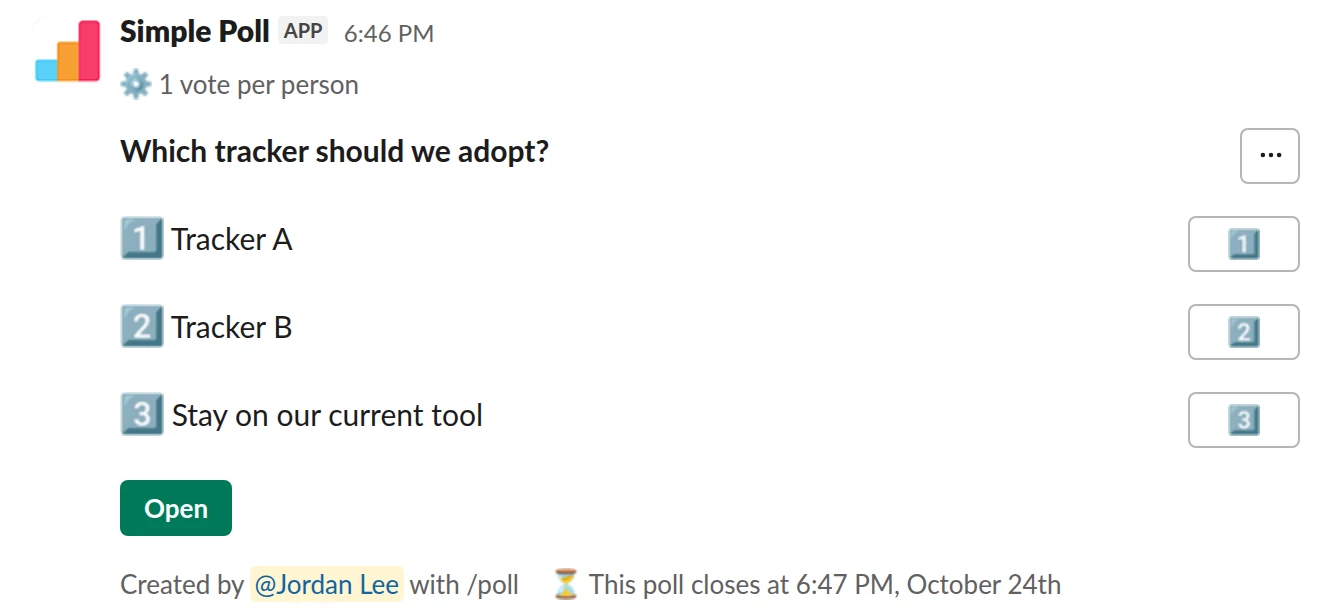
Choice poll. The final pick. One vote each, a reminder, and a fixed close.
/poll "Which tracker should we adopt?" "Tracker A" "Tracker B" "Stay on our current tool" limit 1 close after 2 days remind 1 day before closing
Premium: vote limits, closing automatically, reminders
Limit votes: 1 per personClose automatically: after 2 daysReminder: 24 hours before closing
Round one, the shortlist
Before anyone trials anything, ask what to trial. List two to four candidates plus "Keep what we have". That last option matters: if half the team is happy with the current tool, you want to know before you spend a month migrating.
Allow several picks here. You are finding out which tools are worth anyone's time, not choosing the winner.
Round two, after the trial
Send the trial survey when the trial ends, not halfway through. Ask about the things that decide adoption: how fast people got started, whether it handled their real work, and whether they would keep using it. One rating question per tool, plus one free-text question for blockers, is enough.
Keep it anonymous. People are polite about the tool their manager picked to trial. Anonymous answers tell you what they actually think.
The final pick
End with a single-choice poll that closes on a schedule: limit 1 and close after 2 days (both Premium). One answer per person makes the count clean, and a fixed close stops the decision from drifting.
Post the result with your reasoning, especially if you pick against the vote because of cost or security. A decision people disagree with but understand lands far better than a silent override.
The mistake people make
Asking "Which tool do you prefer?" before anyone has used them. You get votes for the brand people have heard of. Trial first, vote second.
Questions
Should the final vote be binding?
Say up front whether it is. If cost, security or contract terms can overrule it, tell people before they vote, not after.
Can I see who voted for which tool?
Only if the poll is not anonymous. For the shortlist and the final pick, named votes are fine and help you follow up. For the trial survey, use anonymous so the feedback is honest.
Can I export the survey answers?
Yes. On Premium, the poll creator can export results to CSV from the poll settings.
Used by
Related
- Feature prioritization poll for Slack
When you have more candidate features than capacity and need the team, or your stakeholders, to put them in order.
- How to create a survey in Slack
A survey in Simple Poll is one Slack message with several questions behind it. People click the survey's Open button, answer in a pop-up without leaving Slack, and you get the results in the same place. Surveys are a Premium feature, with up to 20 questions each.
- How to close a Slack poll automatically
A poll that never closes never quite decides anything: votes trickle in, the result shifts, and nobody knows when to act. An automatic close fixes the deadline up front. In Simple Poll you add close after and a duration, and the poll closes on its own. Automatic closing is a Premium feature; anyone can close their own poll by hand.
- Slack polls for engineering teams
Engineers will answer a poll if it takes ten seconds and replaces a meeting. They will ignore one that reads like an HR form. The polls that stick in engineering channels are short, tied to the sprint, and end in a decision someone acts on.
- What is a Likert scale?
A Likert scale measures attitudes by asking people how much they agree with a set of statements, usually on five points from "strongly disagree" to "strongly agree". Strictly, one statement is a Likert item, and the scale is several items scored together.