Example polls
Paste any of these into the message box in Slack.
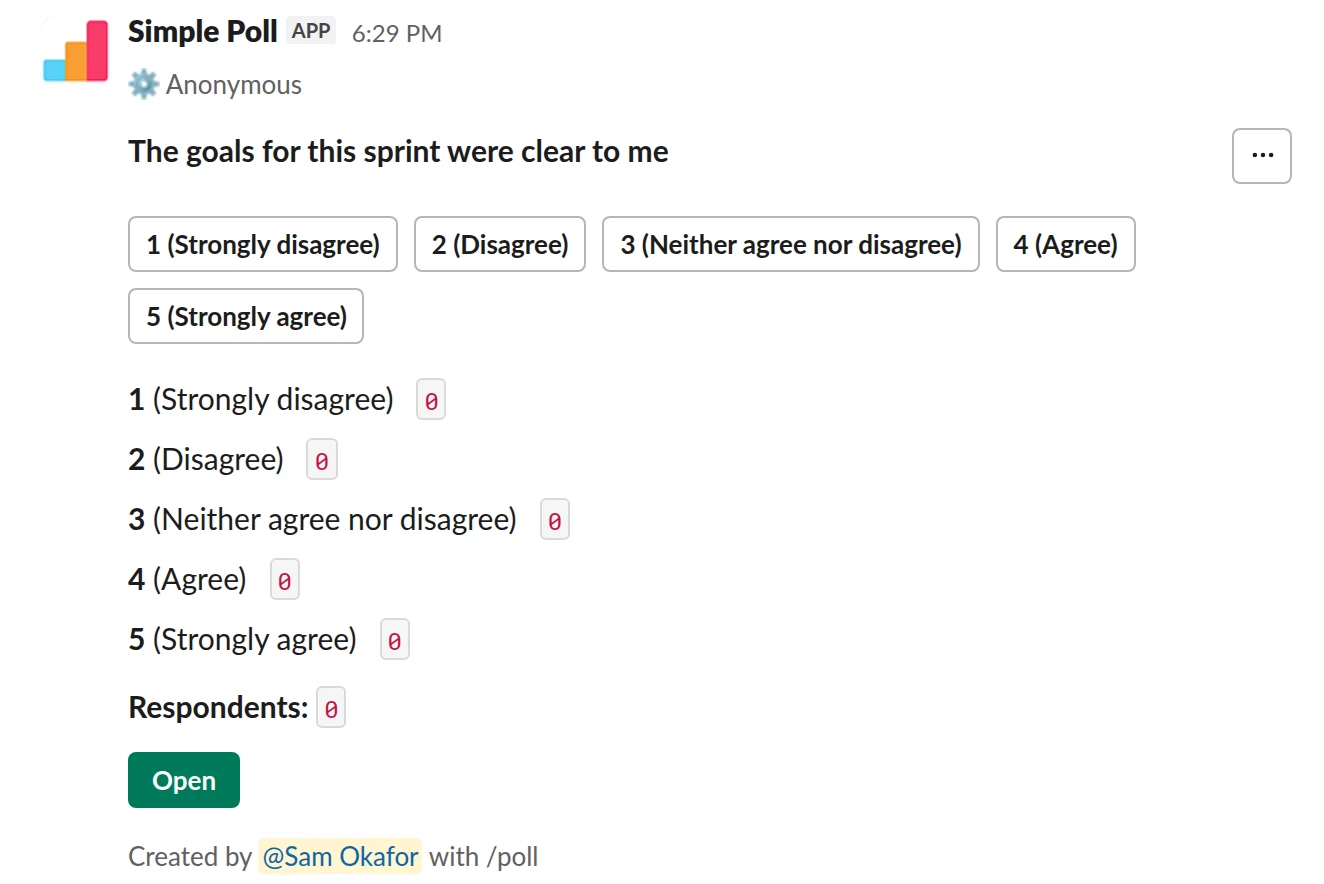
Scale from 1 to 5. A single Likert item as an anonymous 1 to 5 scale poll.
/poll "The goals for this sprint were clear to me" "Strongly disagree" "Disagree" "Neither agree nor disagree" "Agree" "Strongly agree" scale anonymous
Free
Anonymous
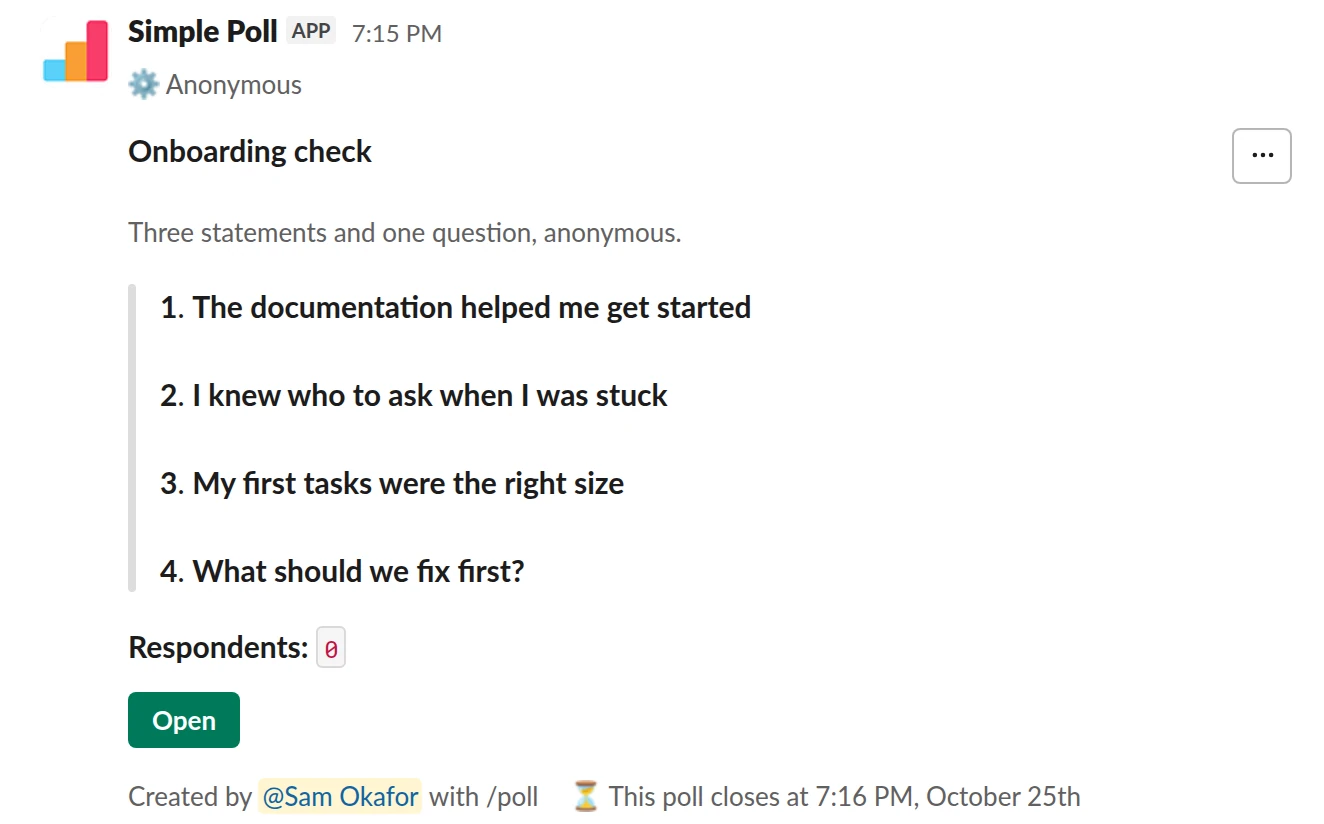
Survey (4 questions). A short multi-item Likert scale as one survey, with an open question at the end.
/poll "Onboarding check" "Three statements and one question, anonymous." anonymous close after 3 days --- "The documentation helped me get started" "Strongly disagree" "Disagree" "Neutral" "Agree" "Strongly agree" scale --- "I knew who to ask when I was stuck" "Strongly disagree" "Disagree" "Neutral" "Agree" "Strongly agree" scale --- "My first tasks were the right size" "Strongly disagree" "Disagree" "Neutral" "Agree" "Strongly agree" scale --- "What should we fix first?" short text optional
Premium: surveys (several questions), closing automatically
AnonymousClose automatically: after 3 days
Item versus scale
"The goals for this sprint were clear to me", rated strongly disagree to strongly agree, is one Likert item. A Likert scale combines several items about the same thing (say, five statements about onboarding) into one score by adding or averaging them. In everyday use, people call a single agree-disagree question a Likert scale too.
Writing good items
- One idea per statement. "My manager is supportive and gives clear feedback" asks two things. Split it.
- Write statements, not questions. Agreement labels only make sense against a claim.
- Keep the middle option. "Neither agree nor disagree" is a real answer. Removing it forces a lean that isn't there.
- Keep wording fixed across rounds. Change a word and you can't compare with last time.
Running one in Simple Poll
Simple Poll's scale poll rates from 1 to 5. Give it no labels, or exactly five labels from
worst to best, so agreement labels fit directly: "Strongly disagree" is 1 and "Strongly
agree" is 5. The results view shows the average and the median. For a multi-item Likert scale, put
several scale questions in one survey (Premium), and add anonymous when the statements
are about people's experience at work.
A 7-point scale isn't possible with scale. You can list seven choice options instead (more
than five options is Premium), but then you don't get a mean or median.
Reading the results
The points are ordered but not necessarily evenly spaced, so the median and the full spread of answers tell you more than the mean on its own. A mean of 3 can be everyone neutral or a team split between 1 and 5. Look at the spread before you report the average.
Questions
Is a 1 to 5 rating a Likert scale?
It is when the five points are labelled as levels of agreement with a statement. A plain 1 to 5 rating of something else ("rate this meeting") is a rating scale, not a Likert item.
Should I use 5 or 7 points?
Both are common. Five is easier to answer on a phone and is what Simple Poll's scale poll
supports.
Related
- How to create a rating scale poll in Slack
A scale poll asks people to rate something from 1 to 5: how clear the plan is, how the sprint went, how confident they are in a date. The poll shows how the votes spread across the five points, and its results view adds the average and median, which a yes or no poll can't give you. Scale polls work on every plan.
- What is the Gallup Q12?
The Gallup Q12 is Gallup's employee engagement survey: twelve statements that employees rate on a five-point agreement scale, from 1 (strongly disagree) to 5 (strongly agree). The items are Gallup's proprietary material.
- What is a pulse survey?
A pulse survey is a short survey, usually one to five questions, sent to the same group on a regular schedule so you can see how things change over time. Common topics are workload, morale and engagement.
- OKR confidence check poll for Slack
When you want an honest, regular read on whether the team believes each key result will land, early enough to change course.