Step by step
-
Pick the channel and the deadline
Post in the channel everyone attending is in, usually your all-hands or announcements channel. Decide when questions close, ideally a few hours before the session so the speaker can prepare.
-
Create the q&a poll
Type
/poll "Questions for Thursday's all-hands" q&a anonymous. Don't add options: people supply the questions. -
Add a close and a reminder (Premium)
Add
close after 2 daysso questions stop at a known time, andremind 2 hours before closingto bring it back to the bottom of the channel for the people who missed it. -
Announce it
Tell people what the session is, who's answering, and that questions are anonymous. Add
@channelto the poll, or post a short message linking to it. -
Answer from the top
In the session, work down the list from the most upvoted. Afterwards, post written answers to the questions you didn't reach.
Example polls
Paste any of these into the message box in Slack.
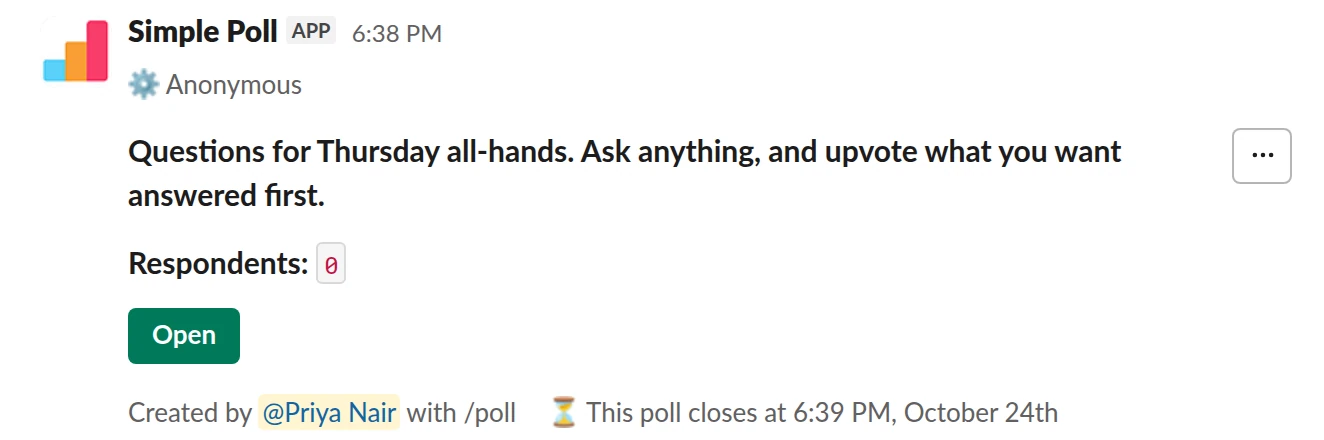
Q&A. The full setup, anonymous, with a deadline and a reminder (Premium).
/poll "Questions for Thursday all-hands. Ask anything, and upvote what you want answered first." q&a anonymous close after 2 days remind 2 hours before closing
Premium: closing automatically, reminders
AnonymousClose automatically: after 2 daysReminder: 2 hours before closing
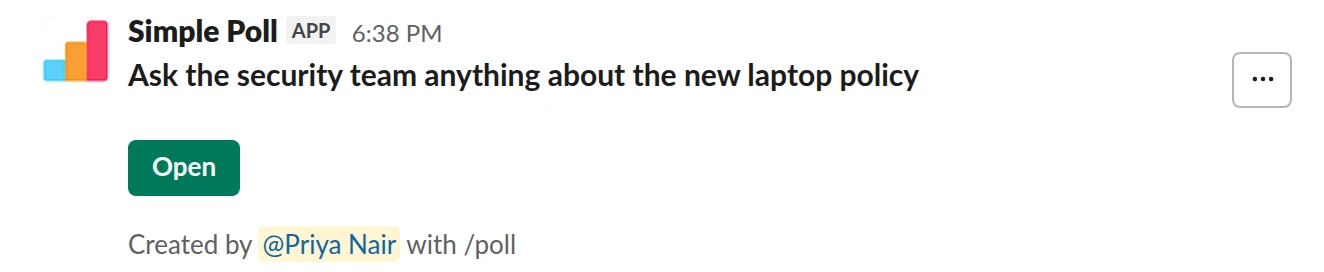
Q&A. A named topic AMA. Free.
/poll "Ask the security team anything about the new laptop policy" q&a
Free
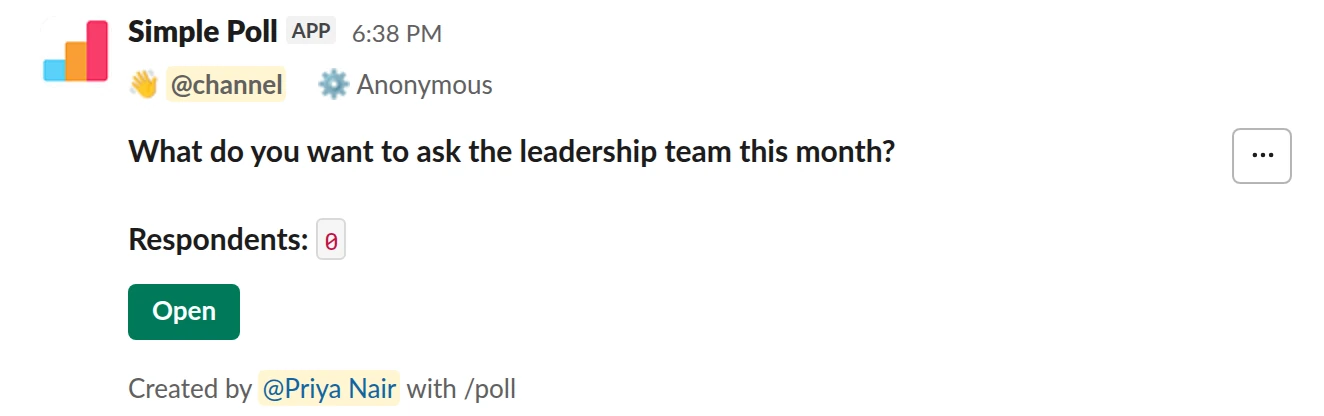
Q&A. Anonymous questions, announced to the channel. Free.
/poll "What do you want to ask the leadership team this month?" q&a anonymous @channel
Free
AnonymousMentions: @channel
Why collect questions in advance
In a live-only AMA, the same few confident people usually ask the questions, and the hard ones rarely surface. Collecting them in Slack ahead of time lets quieter and remote people take part, lets everyone signal which questions matter through upvotes, and gives the speaker time to prepare real answers instead of improvising.
Anonymous or named
For leadership AMAs, make it anonymous. The point is to hear what people won't say with their name attached, and the upvotes show you which of those concerns are widely shared.
For a topic AMA with an expert, such as a new security policy or the benefits renewal, named questions are fine and let the speaker follow up with the person who asked.
Answering well
Answer the top-voted questions even when they're uncomfortable. Skipping the most upvoted question is the fastest way to empty the next AMA. If you can't answer something, say why and when you will.
Group near-duplicate questions and answer them together, and read each question out before answering it so the recording makes sense later.
Make it a habit
A monthly or quarterly AMA works better than an occasional one, because people save questions for it. Use the Schedule button in the poll form to post the question collection on a repeat (Premium), so it goes out a few days before each session.
Questions
Can people upvote questions?
Yes. Everyone can upvote questions in a q&a poll, and the most upvoted rise to the top.
Are questions anonymous?
Only if you add anonymous. Then nobody, including you, sees who asked what.
Can an AMA be part of a survey?
No. A q&a question can't go inside a multi-question survey. Post it as its own poll.
Is there a ready-made AMA template?
Yes. The Template gallery in the poll form includes one for collecting AMA questions, and there's an all-hands questions template here.
Related
- What is an AMA (ask me anything)?
An AMA, short for "ask me anything", is a session where one person or a panel answers open questions from a group, usually with the most popular questions answered first.
- All-hands questions poll for Slack
In the days before an all-hands, town hall or leadership AMA, so the questions people actually care about get asked, including the uncomfortable ones.
- How to create an anonymous poll in Slack
An anonymous poll in Simple Poll hides who voted for what from everyone, including the person who created it. The poll still counts every vote and shows the totals. It's free on every plan.
- How to close a Slack poll automatically
A poll that never closes never quite decides anything: votes trickle in, the result shifts, and nobody knows when to act. An automatic close fixes the deadline up front. In Simple Poll you add close after and a duration, and the poll closes on its own. Automatic closing is a Premium feature; anyone can close their own poll by hand.
- What is psychological safety?
Psychological safety is "a shared belief held by members of a team that the team is safe for interpersonal risk taking", as Amy Edmondson defined it in 1999. In practice: people can ask, disagree, admit mistakes and raise problems without fear of embarrassment or punishment.