Example polls
Paste any of these into the message box in Slack.
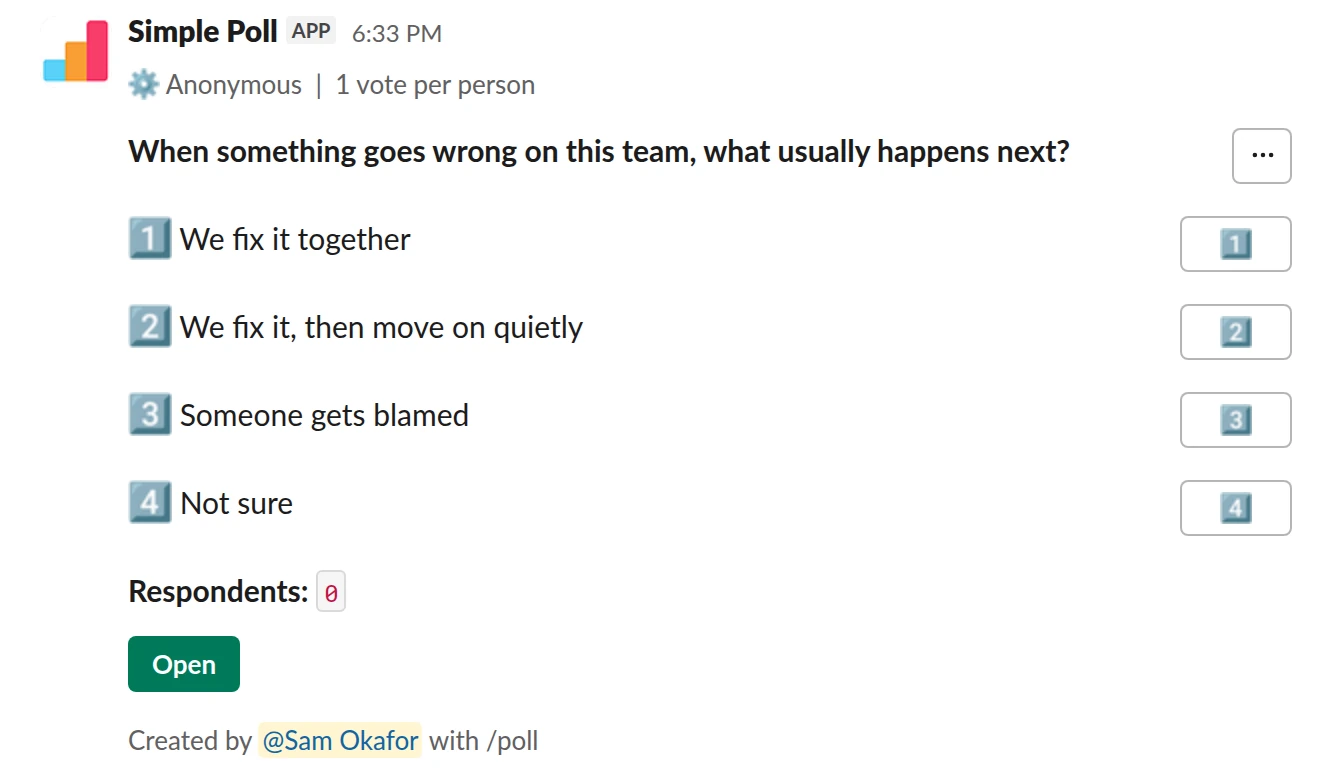
Choice poll. A behaviour-based question, anonymous, one answer each.
/poll "When something goes wrong on this team, what usually happens next?" "We fix it together" "We fix it, then move on quietly" "Someone gets blamed" "Not sure" anonymous limit 1
Premium: vote limits
AnonymousLimit votes: 1 per person
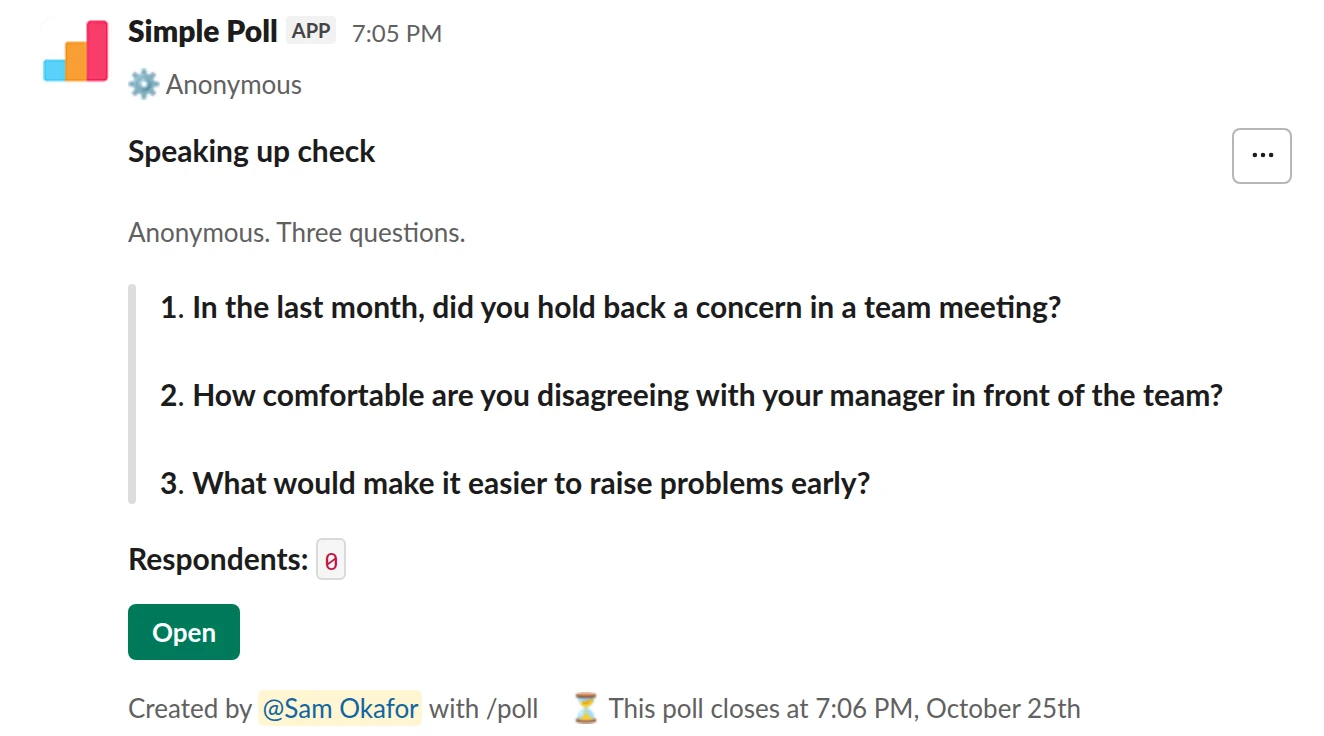
Survey (3 questions). A short anonymous survey on speaking up.
/poll "Speaking up check" "Anonymous. Three questions." anonymous close after 3 days --- "In the last month, did you hold back a concern in a team meeting?" "Never" "Once or twice" "Often" limit 1 --- "How comfortable are you disagreeing with your manager in front of the team?" scale --- "What would make it easier to raise problems early?" short text optional
Premium: surveys (several questions), closing automatically
AnonymousClose automatically: after 3 days
What it looks like
- People say "I don't know" and "I got that wrong" in front of the team.
- Juniors disagree with seniors in the meeting, not afterwards in DMs.
- Bad news arrives early.
- Questions in retros get real answers instead of silence.
It isn't the same as being nice or agreeing. A psychologically safe team argues more openly, because disagreement doesn't cost anyone.
Asking about it
You can't measure psychological safety by asking people in public whether they feel safe to speak up. Ask anonymously, and ask about behaviour rather than feelings: "When something goes wrong on this team, what usually happens next?" is easier to answer honestly than "Do you feel safe?". Track the same questions over time rather than reading one round.
Where anonymous polls fit, and where they don't
An anonymous poll in Slack lets people raise things they wouldn't say with their name on it, and that's useful on any team. But it's a workaround, not a cure. If honest input only arrives anonymously, that tells you something about the team.
The signal to watch: what you do with what comes in. Acknowledge hard answers in public, thank people for them, and act on one. That builds the safety that eventually makes the anonymity less necessary.
Questions
Is psychological safety the same as trust?
Close, but not the same. Trust is usually about one relationship. Psychological safety is a shared belief about the group as a whole.
Do anonymous surveys build psychological safety?
Not by themselves. They collect honest input. Safety builds when people see that speaking up, including with their name attached, leads to something good.
Related
- What is an anonymous poll?
An anonymous poll records votes without showing who cast them: everyone sees the totals, and nobody can see which person picked which answer. In Simple Poll that includes the person who created the poll.
- What is a retrospective?
A retrospective is a meeting at the end of a piece of work where the team looks at how it worked, not what it built, and picks changes to try next time. In Scrum it closes every sprint.
- Anonymous manager feedback survey for Slack
When a manager wants to know how they're doing from the people who report to them, and wants answers more honest than a one-to-one will get.
- Team mood check-in poll for Slack
When you want an early, honest signal on how the team is feeling, before it shows up as missed deadlines or resignations.