Example polls
Paste any of these into the message box in Slack.
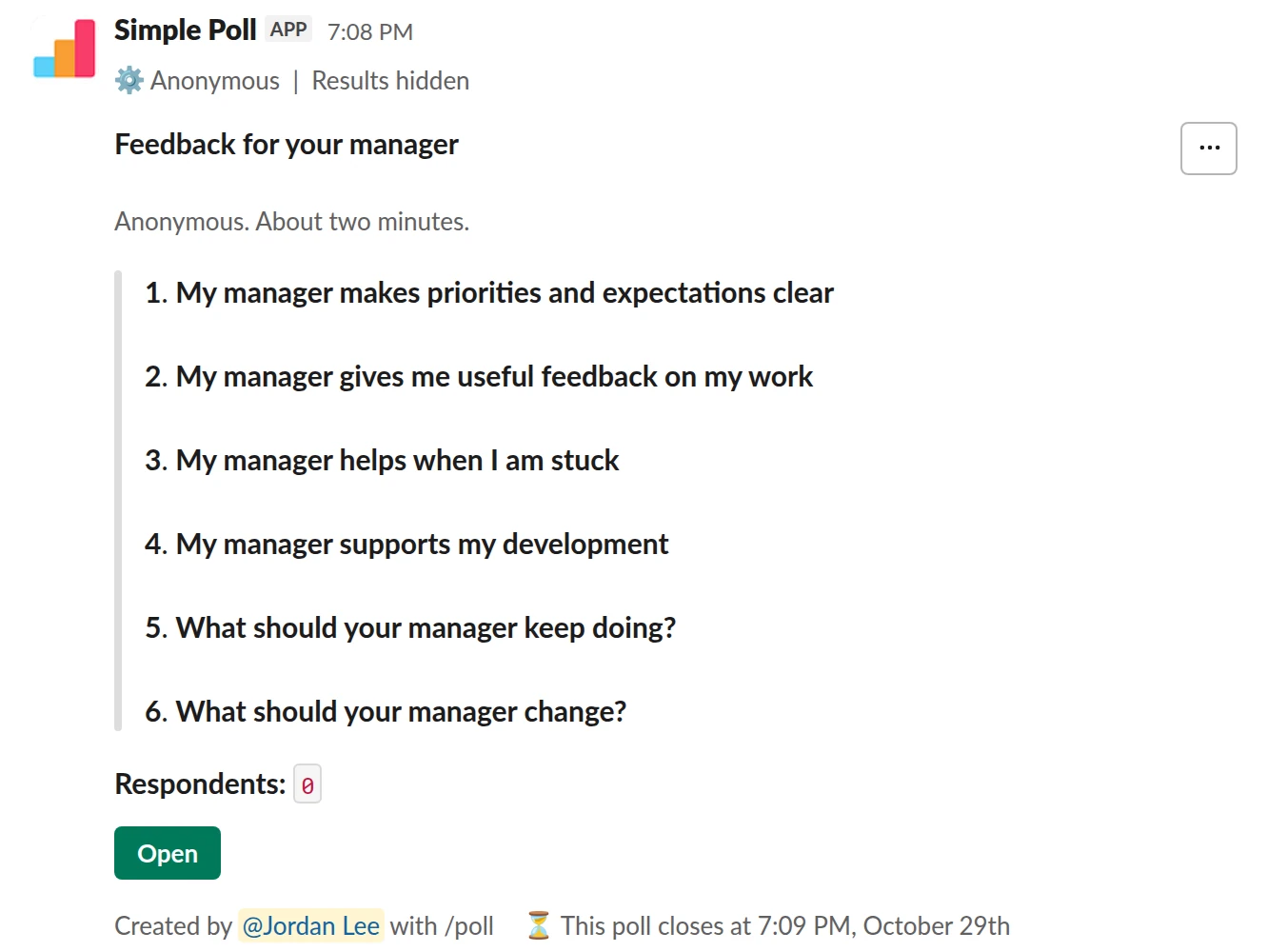
Survey (6 questions). The full upward feedback survey, results visible only to whoever creates it.
/poll "Feedback for your manager" "Anonymous. About two minutes." anonymous show results to creator close after 7 days remind 1 day before closing --- "My manager makes priorities and expectations clear" "Strongly disagree" "Disagree" "Neutral" "Agree" "Strongly agree" scale --- "My manager gives me useful feedback on my work" "Strongly disagree" "Disagree" "Neutral" "Agree" "Strongly agree" scale --- "My manager helps when I am stuck" "Strongly disagree" "Disagree" "Neutral" "Agree" "Strongly agree" scale --- "My manager supports my development" "Strongly disagree" "Disagree" "Neutral" "Agree" "Strongly agree" scale --- "What should your manager keep doing?" short text optional --- "What should your manager change?" short text optional
Premium: surveys (several questions), closing automatically, reminders, results for the creator only
AnonymousShow results: only visible to youClose automatically: after 7 daysReminder: 24 hours before closing
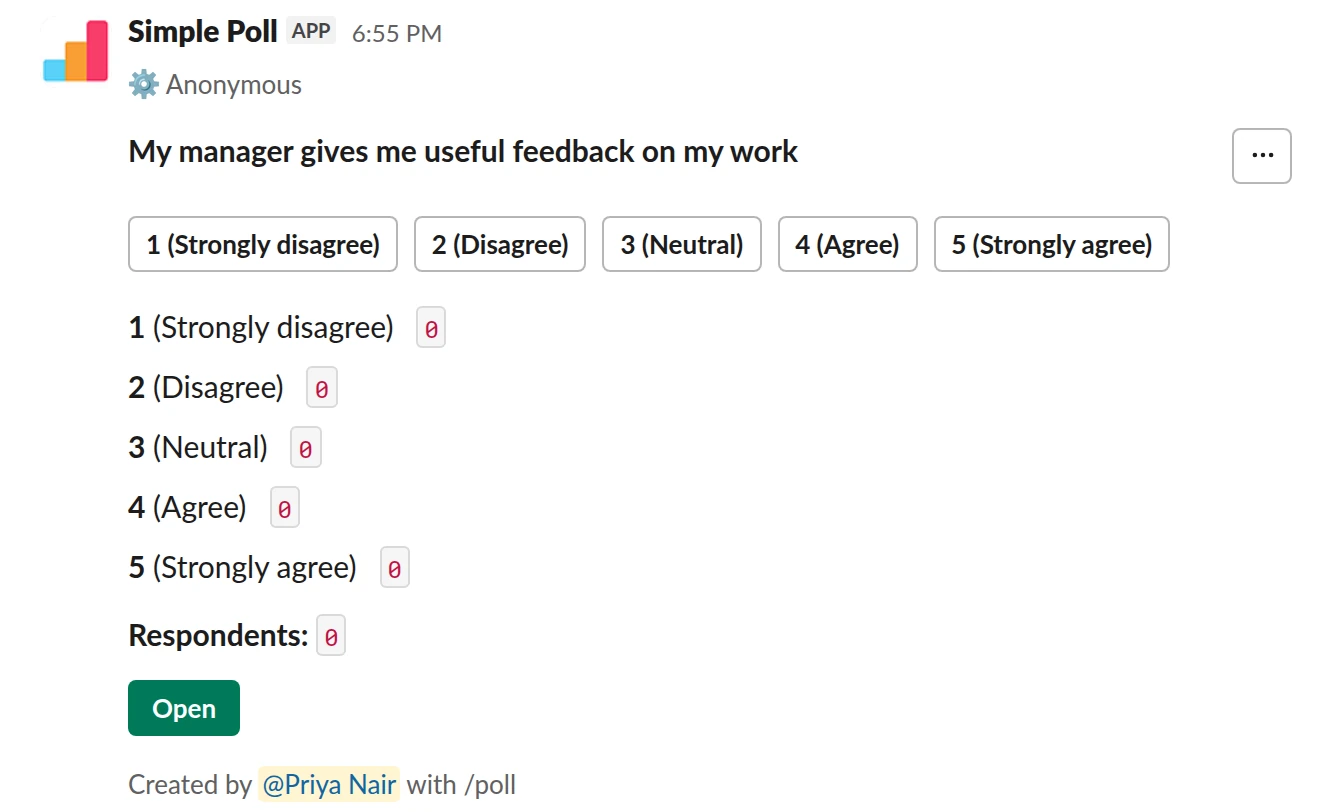
Scale from 1 to 5. One statement on Free, for a manager checking a single habit.
/poll "My manager gives me useful feedback on my work" "Strongly disagree" "Disagree" "Neutral" "Agree" "Strongly agree" scale anonymous
Free
Anonymous
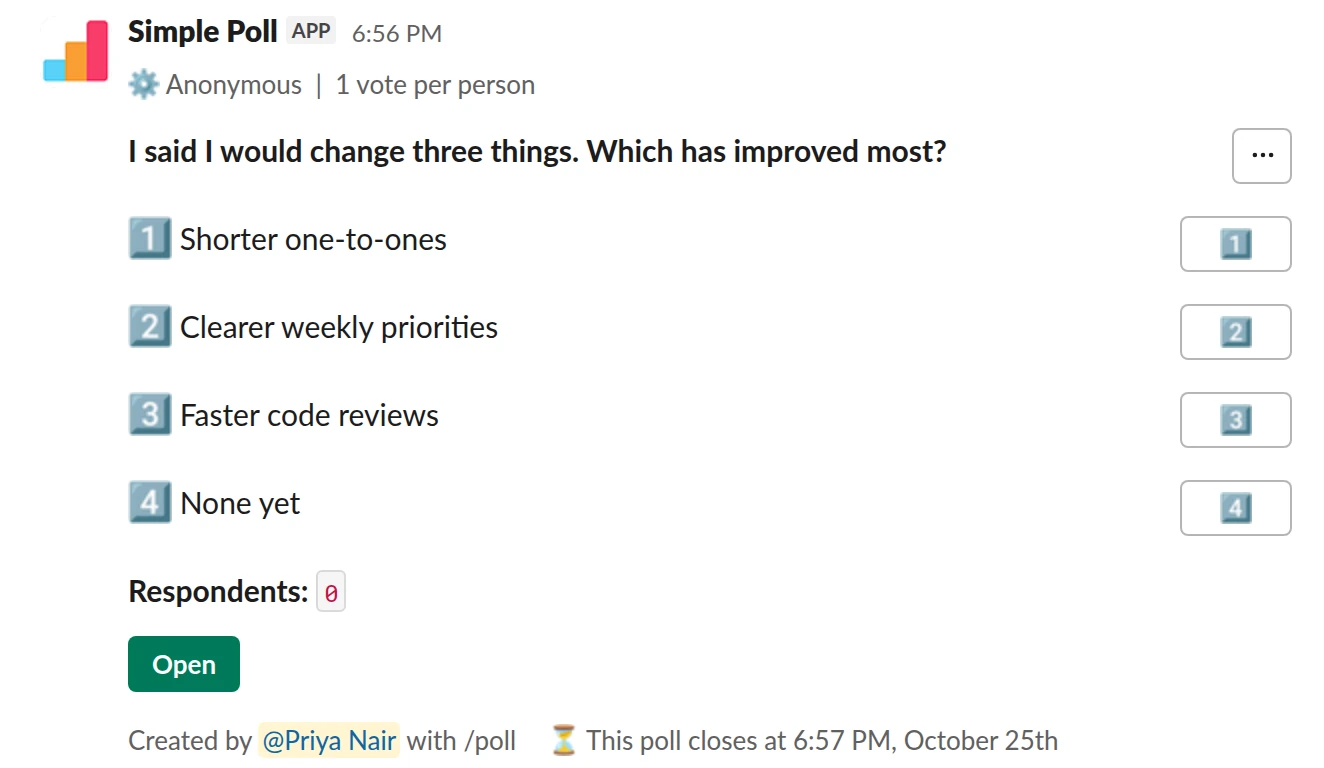
Choice poll. The follow-up a few months later. Ask whether the changes landed.
/poll "I said I would change three things. Which has improved most?" "Shorter one-to-ones" "Clearer weekly priorities" "Faster code reviews" "None yet" anonymous limit 1 close after 3 days
Premium: vote limits, closing automatically
AnonymousLimit votes: 1 per personClose automatically: after 3 days
How to word it
Rate behaviours, not the person. "My manager gives me useful feedback on my work" is something a manager can change. "My manager is good" isn't.
Five or six statements is enough, on the same agree-disagree scale, covering:
- Clear priorities and expectations
- Useful feedback on my work
- Support when I'm stuck
- Recognition for good work
- Interest in my development
Close with two optional free-text questions: what should they keep doing, and what should they change.
Make the anonymity real
Use anonymous. Nobody, the creator included, sees who answered what.
On a team of three, anonymity is thin no matter what the tool does: free-text answers give people away by their writing. Below about five reports, either drop the free text or combine teams under one skip-level manager.
For more distance, have someone from HR or People create the poll with
show results to creator (Premium), so the results go to them first and they share the
themes with the manager.
When to send it
Twice a year, away from performance reviews. Feedback collected in review season reads
like a negotiation. Leave it open for a week, with close after 7 days (Premium) and a
reminder before it closes.
What to do with the results
The manager should share the two or three main themes with the team, say what they'll change, and then do it. Rerun the same survey six months later. People keep answering only if the first round led somewhere.
Questions
Can the manager see who said what?
Not with anonymous. Nobody sees who answered what, including the poll's creator. On a
very small team, free-text answers can still give people away, so keep that in mind.
Who should create the poll?
Whoever should see the raw results. If that's HR rather than the manager, have HR create
it with show results to creator (Premium).
What needs Premium?
Multi-question surveys, show results to creator, limit, close after and reminders.
Start a 14-day free trial with /simplepoll trial.
Used by
Related
- New hire onboarding feedback survey for Slack
At the end of a new hire's first week and again around day 30, while they still remember what was confusing and before they've stopped noticing it.
- Gallup Q12-style engagement survey for Slack
When you want a structured engagement check covering the basics of a good job, without sending people to a separate survey tool.
- What is psychological safety?
Psychological safety is "a shared belief held by members of a team that the team is safe for interpersonal risk taking", as Amy Edmondson defined it in 1999. In practice: people can ask, disagree, admit mistakes and raise problems without fear of embarrassment or punishment.
- How to hide poll results until the poll closes
When people can see a running tally, they tend to pile onto the leading option or skip voting once the result looks settled. Hiding the results until the poll closes gets you each person's own answer. In Simple Poll it's one keyword, and it works on every plan.
- Slack polls for managers and team leads
A team lead's job is mostly two things: deciding, and finding out what you do not know. Both get easier with a handful of well-timed polls. The point is not to vote on everything. It is to stop spending a meeting on questions a poll answers in an hour, and to hear the things your team would not say to your face.