Example polls
Paste any of these into the message box in Slack.
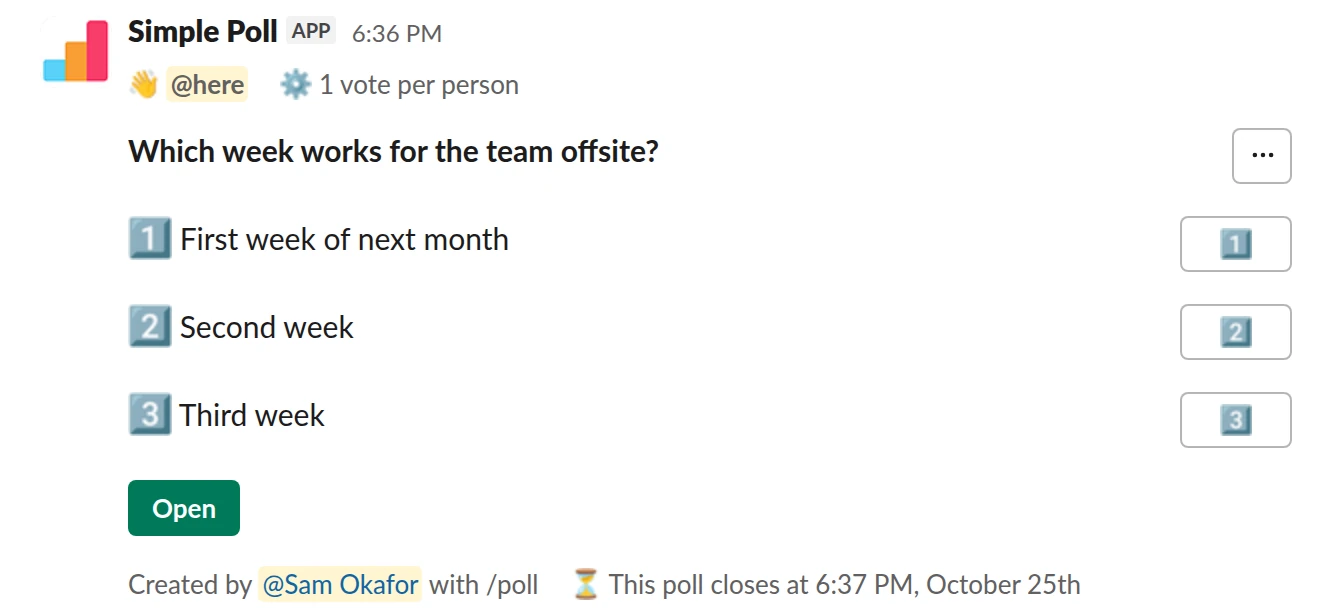
Choice poll. One vote per person so votes equal respondents, with a deadline, a reminder and a channel mention.
/poll "Which week works for the team offsite?" "First week of next month" "Second week" "Third week" limit 1 close after 3 days remind 1 day before closing @here
Premium: vote limits, closing automatically, reminders
Limit votes: 1 per personClose automatically: after 3 daysReminder: 24 hours before closingMentions: @here
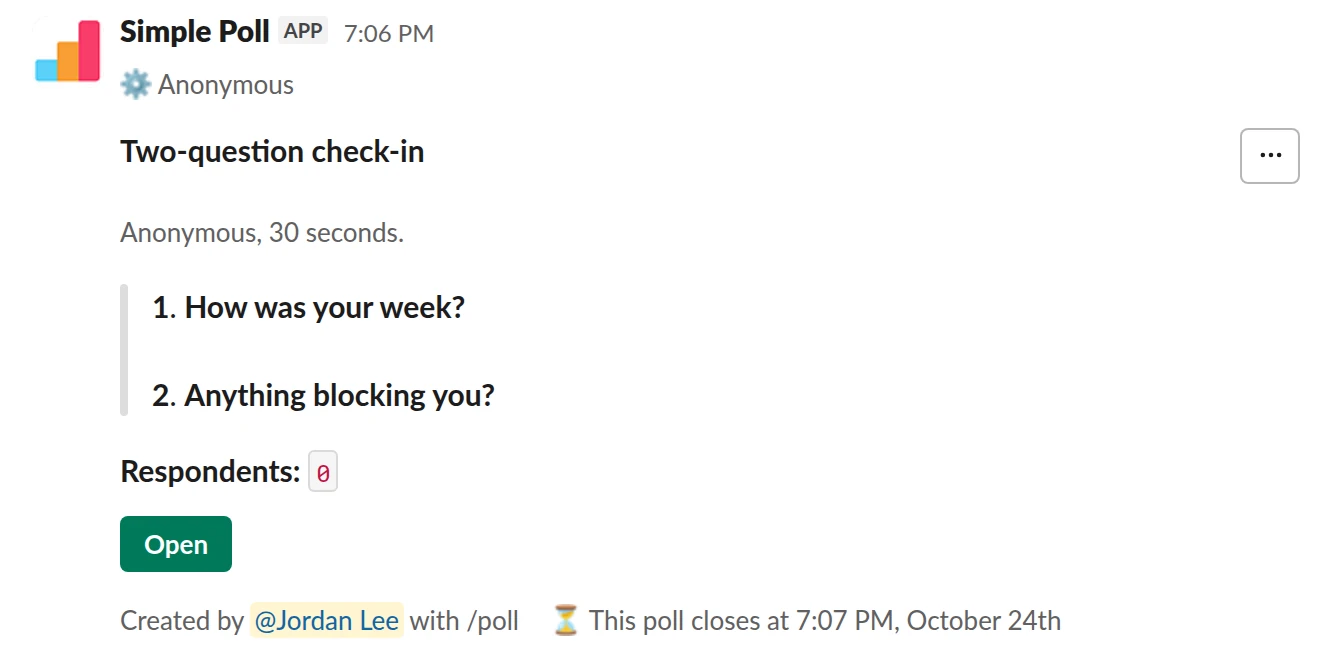
Survey (2 questions). A short anonymous survey that reposts itself once, a day after posting.
/poll "Two-question check-in" "Anonymous, 30 seconds." anonymous close after 2 days remind 24 hours after posting --- "How was your week?" scale --- "Anything blocking you?" short text optional
Premium: surveys (several questions), closing automatically, reminders
AnonymousClose automatically: after 2 daysReminder: 24 hours after posting
Calculating it
Response rate = respondents ÷ people asked × 100. Two things to get right:
- The top of the fraction is people, not votes. In a poll where people can pick
several options, total votes overstate turnout. With
limit 1(Premium), each person casts one vote, so votes equal people. - The bottom is the people you meant to ask. A channel with 60 members that includes other teams, bots and guests isn't an audience of 60. Count the group the question was for.
Why it matters
The people who answer are often not a random slice of the people you asked: those with strong views, or who happen to be online when you post, are likelier to respond. A low response rate can tilt the result either way. Report the rate next to the result, every time.
Raising it in Slack
- Post where people already are, in the team channel, not a channel they've muted.
- Keep it short. One question beats five. See survey fatigue.
- Make it anonymous when the topic is personal.
- Give it a deadline with
close after(Premium), so it isn't something to get to later. - Remind once.
remind 1 day before closingorremind 24 hours after posting(Premium) reposts the poll at the bottom of the channel. - Mention the channel with
@herefor things that need everyone, sparingly. - Share the result and what you did with it. People answer the next poll when the last one changed something.
Questions
What is a good response rate for an internal poll?
There's no fixed bar. Compare against your own past polls with the same audience, and be cautious with results from a small minority of the group.
Can I see who hasn't answered an anonymous poll?
No. Anonymous means nobody can see who answered, so you can't see who didn't either. Remind the whole channel instead.
Related
- What is survey fatigue?
Survey fatigue is when people are asked for feedback so often, or at such length, that they stop answering or start answering carelessly.
- How to close a Slack poll automatically
A poll that never closes never quite decides anything: votes trickle in, the result shifts, and nobody knows when to act. An automatic close fixes the deadline up front. In Simple Poll you add close after and a duration, and the poll closes on its own. Automatic closing is a Premium feature; anyone can close their own poll by hand.
- Weekly pulse survey for Slack
When an annual engagement survey is too slow to catch problems and you want a light, regular read on how the team is doing.
- What is a quorum?
A quorum is the minimum number of members who must take part, by attending a meeting or by voting, for a group's decision to count. Under Robert's Rules of Order, the default is a majority of the entire membership unless the group's own rules set another number.