Example polls
Paste any of these into the message box in Slack.
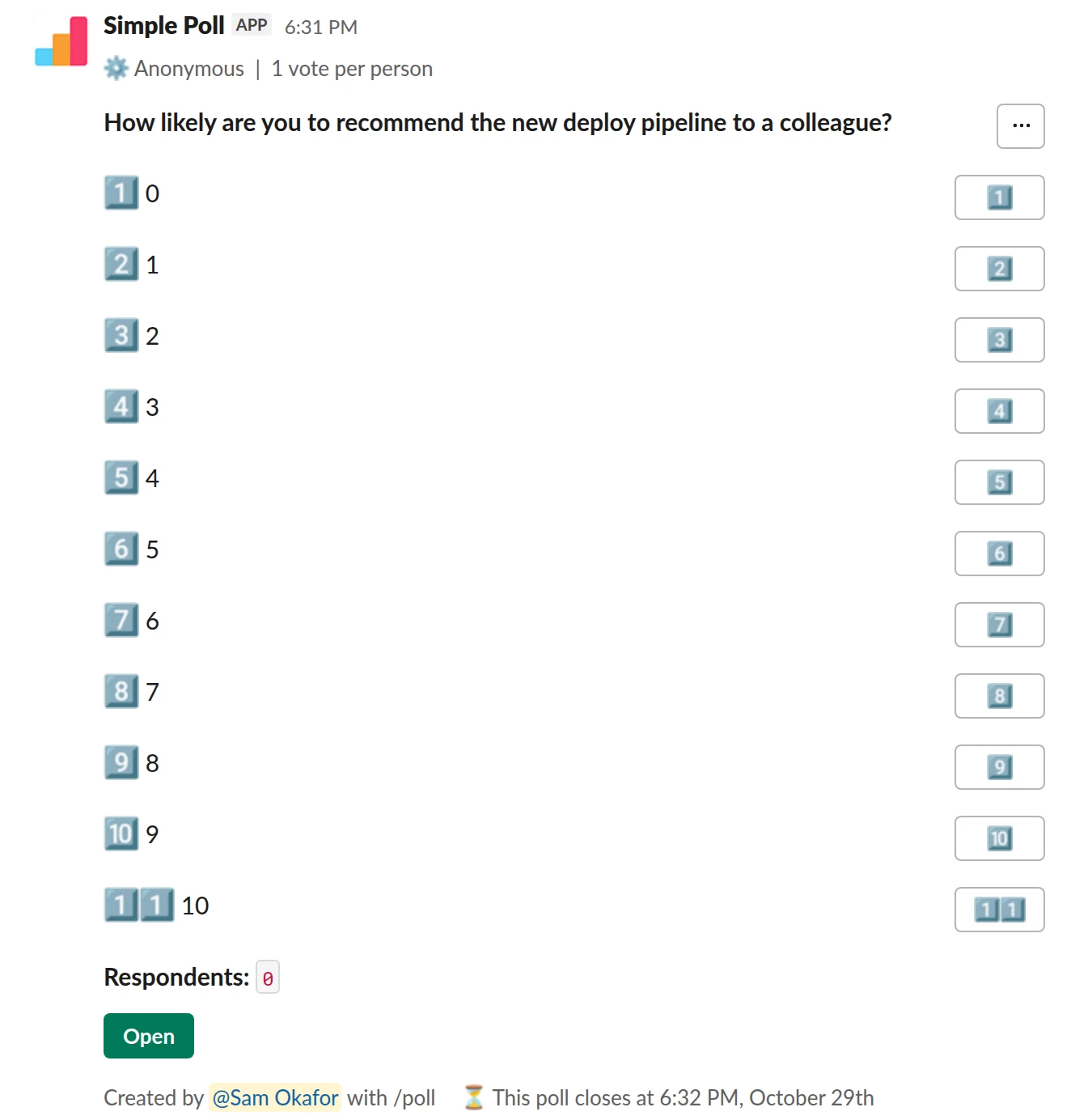
Choice poll. An internal NPS for a tool your platform team runs, open for a week.
/poll "How likely are you to recommend the new deploy pipeline to a colleague?" "0" "1" "2" "3" "4" "5" "6" "7" "8" "9" "10" limit 1 anonymous close after 7 days
Premium: more than 5 options, vote limits, closing automatically
AnonymousLimit votes: 1 per personClose automatically: after 7 days
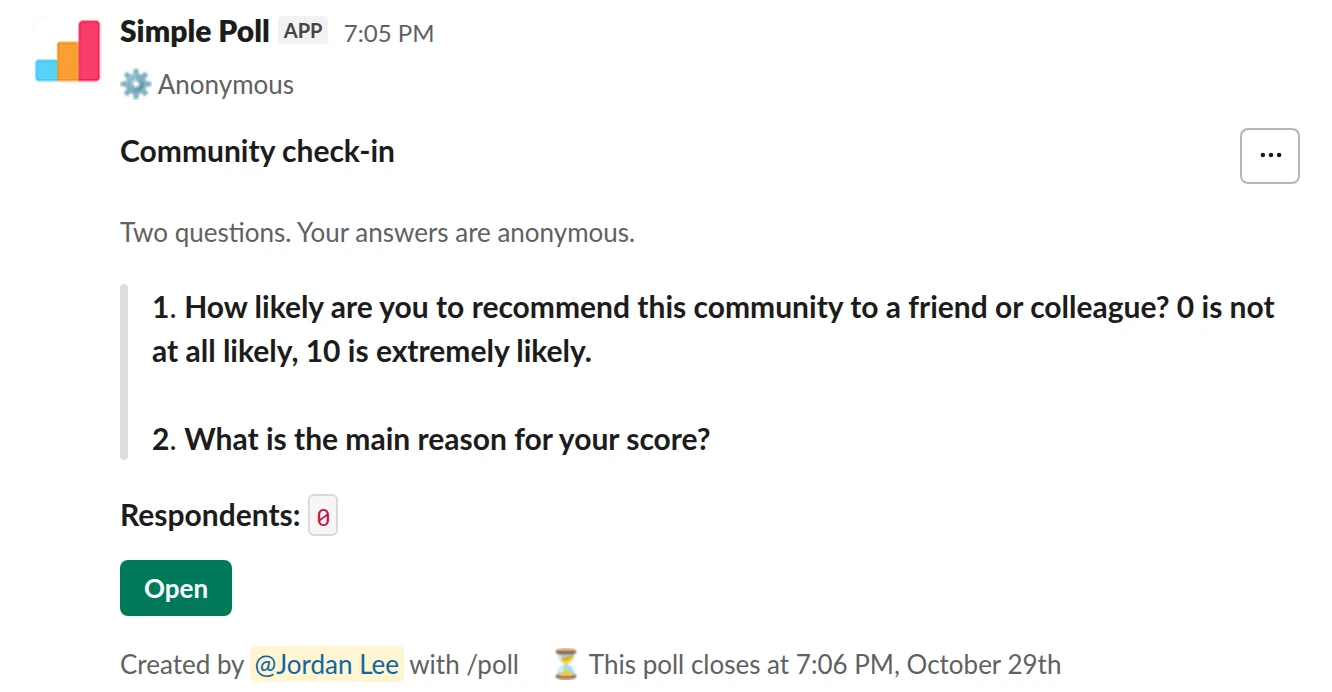
Survey (2 questions). The score and the reason, for a Slack community.
/poll "Community check-in" "Two questions. Your answers are anonymous." anonymous close after 7 days --- "How likely are you to recommend this community to a friend or colleague? 0 is not at all likely, 10 is extremely likely." "0" "1" "2" "3" "4" "5" "6" "7" "8" "9" "10" limit 1 --- "What is the main reason for your score?" short text optional
Premium: surveys (several questions), more than 5 options, closing automatically
AnonymousClose automatically: after 7 days
How the score works
Bain's question is "How likely are you to recommend us to a friend or colleague?", scored 0 to 10. Answers fall into three groups: promoters (9 or 10), passives (7 or 8) and detractors (0 to 6). NPS is % promoters minus % detractors. Passives only count in the total.
If 100 customers answer, 50 give a 9 or 10 and 20 give 6 or lower, the NPS is 50 minus 20, which is +30. Bain also asks a second, open question: the main reason for the score. That's where the useful detail is.
Who answered matters
The people who answer a survey may not represent everyone you asked. Bain suggests that if you can't learn about the non-responders, you treat them conservatively rather than assume they look like the people who did answer. Report your response rate next to the score.
Running NPS in Slack
NPS in Slack makes sense when the people you're asking are in Slack with you: members of your customer community workspace, beta users in a shared channel, or colleagues who use a tool your team runs internally.
Simple Poll's scale poll rates 1 to 5, which can't produce an NPS. Use a choice poll with
eleven options, "0" to "10", plus limit 1 so each person gives one score. Both need
Premium (more than five options, vote limits). Add anonymous if people would hold back,
and close after so you report a fixed result. Then count the 9 and 10 votes, count the 0
to 6 votes, and divide each by the total.
Questions
Why 0 to 10 and not 1 to 5?
The promoter, passive and detractor bands are defined on the 11-point scale. A five-point rating can't be split the same way, so there's no honest conversion.
Can I run NPS for free in Simple Poll?
Not the standard version. Eleven options and a one-vote limit are Premium features. The
14-day trial (/simplepoll trial) covers them; see pricing.
Is a negative NPS bad?
It means more detractors than promoters among the people who answered. Read the reasons before reacting to the number.
Related
- What is eNPS (employee Net Promoter Score)?
Employee Net Promoter Score (eNPS) asks employees how likely they are to recommend their company as a place to work, on a scale from 0 to 10. The score is the percentage of promoters (9 or 10) minus the percentage of detractors (0 to 6), so it runs from -100 to +100.
- eNPS survey for Slack
When you want one comparable number for how likely people are to recommend working here, tracked quarter to quarter.
- What is response rate?
Response rate is the share of people you asked who actually answered: the number of respondents divided by the number of people invited, times 100.
- What is a single-choice poll?
A single-choice poll lets each voter pick exactly one option. The result shows how a group splits when everyone has to commit to a single answer.